
THE SCIENCE BEHIND FOTONA FACELIFT : 7D FACIAL REJUVENATION
Multi-depth laser remodeling of visible and structural features of skin aging
What the evidence supports:
Peer-reviewed human studies of 2940-nm Er:YAG and 1064-nm Nd:YAG facial rejuvenation demonstrate improvements in wrinkles, texture, elasticity, laxity and pigmentation, with histologic evidence of dermal remodeling and neocollagenesis. The strongest claim is improvement or partial reversal of features of skin aging — not reversal of chronological aging itself.
WHY THE DUAL-WAVELENGTH APPROACH IS DIFFERENT
2940-nm Er:YAG
Very high water absorption allows precise superficial resurfacing and, with SMOOTH pulse delivery, controlled thermal collagen remodeling.
1064-nm Nd:YAG
Deeper optical penetration permits dermal/subdermal thermal effects and bulk heating with relatively limited epidermal injury.
CLINICAL AND BIOLOGIC EVIDENCE
Randomized split-face trial
20 patients: combined 2940-nm Er:YAG + 1064-nm Nd:YAG produced greater improvement in multiple photoaging parameters than either wavelength alone.
PMID: 34431819 (tel:34431819)
Histology + immunohistochemistry
A four-step Er:YAG/Nd:YAG facial protocol produced significant clinical improvement accompanied by structural changes in the epidermis and dermis.
PMID: 33629512 (tel:33629512)
Human biopsy / neocollagenesis
Fractional Er:YAG treatment was associated with increased epidermal thickness and increased collagen I, III, VII and tropoelastin, with changes observed for months.
PMID: 24641603 (tel:24641603)
SMOOTH-mode tissue interaction
Human eyelid histology demonstrated controlled thermal/coagulative effects from repetitive 2940-nm Er:YAG pulse delivery, supporting nonablative thermal remodeling.
PMID: 15334619 (tel:15334619)
Randomized split-face + OCT
Intraoral Er:YAG SMOOTH treatment of nasolabial folds produced objective increases in OCT-measured dermal thickness.
PMID: 31794102 (tel:31794102)
Objective 3-D facial imaging
A prospective Fotona 4D study documented measurable facial landmark displacement/tightening and improvements in nasolabial folds and pores after treatment.
PMID: 41472528 (tel:41472528)
WHAT THIS MEANS FOR FOTONA 7D
The scientific rationale is multi-depth, multimodal treatment: complementary Er:YAG and Nd:YAG tissue interactions can be combined with different pulse structures and delivery approaches to address superficial photoaging, dermal collagen remodeling and deeper thermal tightening. This is fundamentally different from describing facial rejuvenation as a single resurfacing step.
What the evidence supports: Fotona’s complementary Er:YAG and Nd:YAG wavelengths allow treatment at different tissue depths. Peer-reviewed human studies demonstrate clinical improvement together with objective and histologic evidence of tissue remodeling.
what makes our clinic different? A physician- performed Fotona Facelift
At Pristine Wellness Center, Fotona 4D and 7D facelift treatments are performed personally by Dr. Izadi, a quadruple board-certified physician with more than 30 years of medical experience. Patients seeking physician-directed aesthetic care visit our clinics from throughout the Bay area and California. We also have patients from other states coming back for their needs.
Lorem ipsum dolor sit amet, consectetur adipiscing elit. Ut elit tellus, luctus nec ullamcorper mattis, pulvinar dapibus leo.
SELECTED PEER-REVIEWED REFERENCES
Song W, et al. Efficacy of Erbium-Doped Yttrium Aluminium Garnet 2,940 and 1,064 nm Laser Treatment for Facial Rejuvenation—A Randomized Controlled Split-Face Clinical Trial. Dermatologic Surgery. 2021. PMID: 34431819(tel:34431819).
Shanina NA, et al. Histological and immunohistochemical changes in facial skin treated with combined ablative and non-ablative laser therapy. Journal of Cosmetic Dermatology. 2021.PMID: 33629512(tel:33629512).
El-Domyati M, et al. Multiple fractional Er:YAG laser sessions for upper facial rejuvenation: clinical and histological implications and expectations. Journal of Cosmetic Dermatology. 2014. PMID: 24641603(tel:24641603).
Drnovsek-Olup B, et al. Repetitive Er:YAG laser irradiation of human skin: a histological evaluation. Lasers in Surgery and Medicine. 2004. PMID: 15334619(tel:15334619).
Optical coherence tomographic (OCT) evaluation of intraoral non-ablative Er:YAG laser (SMOOTH mode) in rejuvenation of nasolabial folds: prospective randomized split-face study. PMID: 31794102(tel:31794102).
Qi J, et al. Three-Dimensional Imaging of Dynamic Changes After Nd:YAG/Er:YAG Laser Skin Tightening: A Prospective Study. Lasers in Surgery and Medicine. PMID: 41472528(tel:41472528).
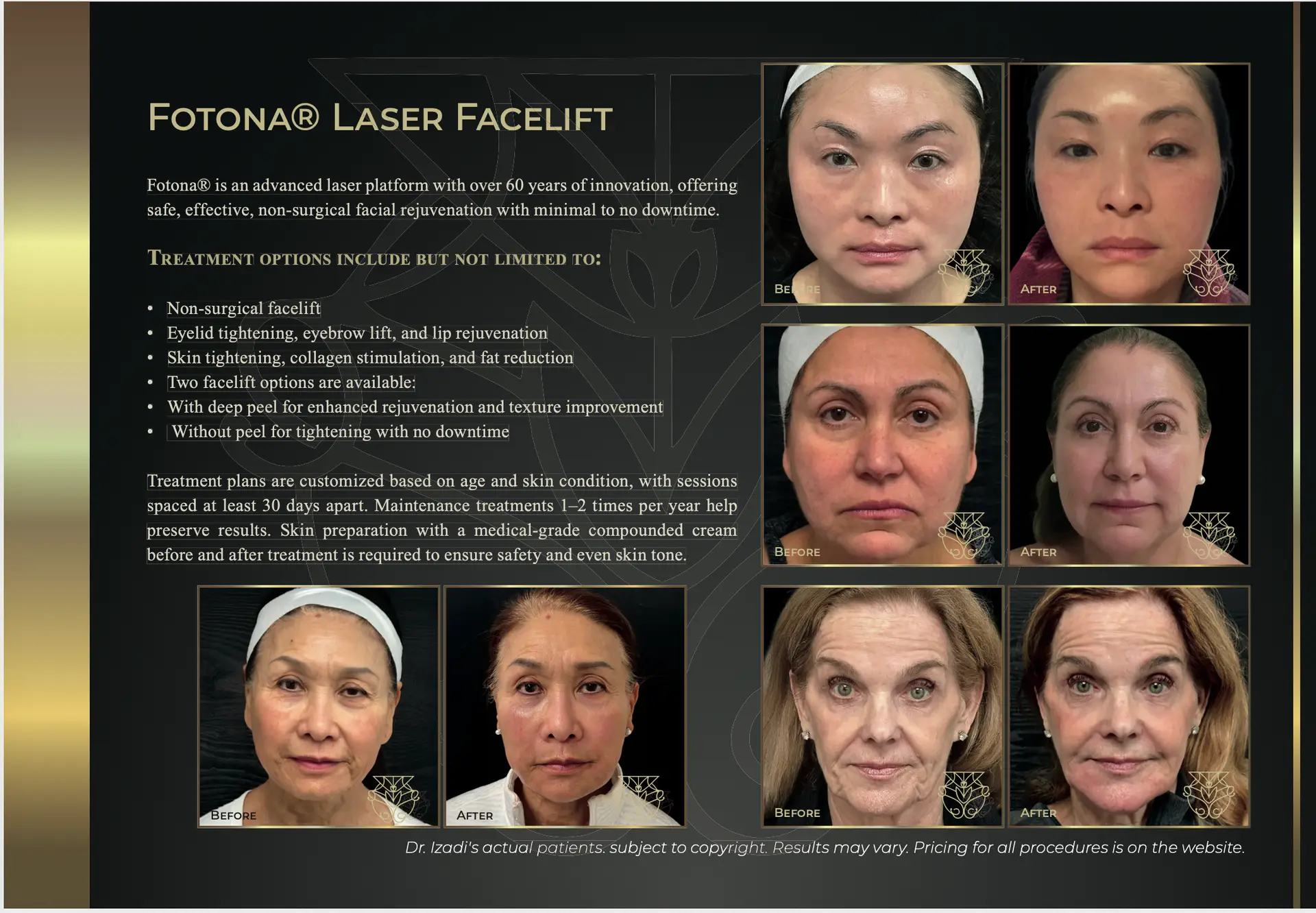
Fotona 7D facelift is a nonsurgical facelift with no needles, no cuts and no scars but comparable results to surgical facelift. The number of sessions: one session for every decade of life, for example a 50 year old needs 5 sessions at least 30 days apart, then once or twice a year maintenance which depends on how fast you age. There is a compounded cream to apply for at least one month prior to the first session and continue up to one month after the last session to prevent PIH ( post inflammatory hyperpigmentation) which can happen with any energy device.
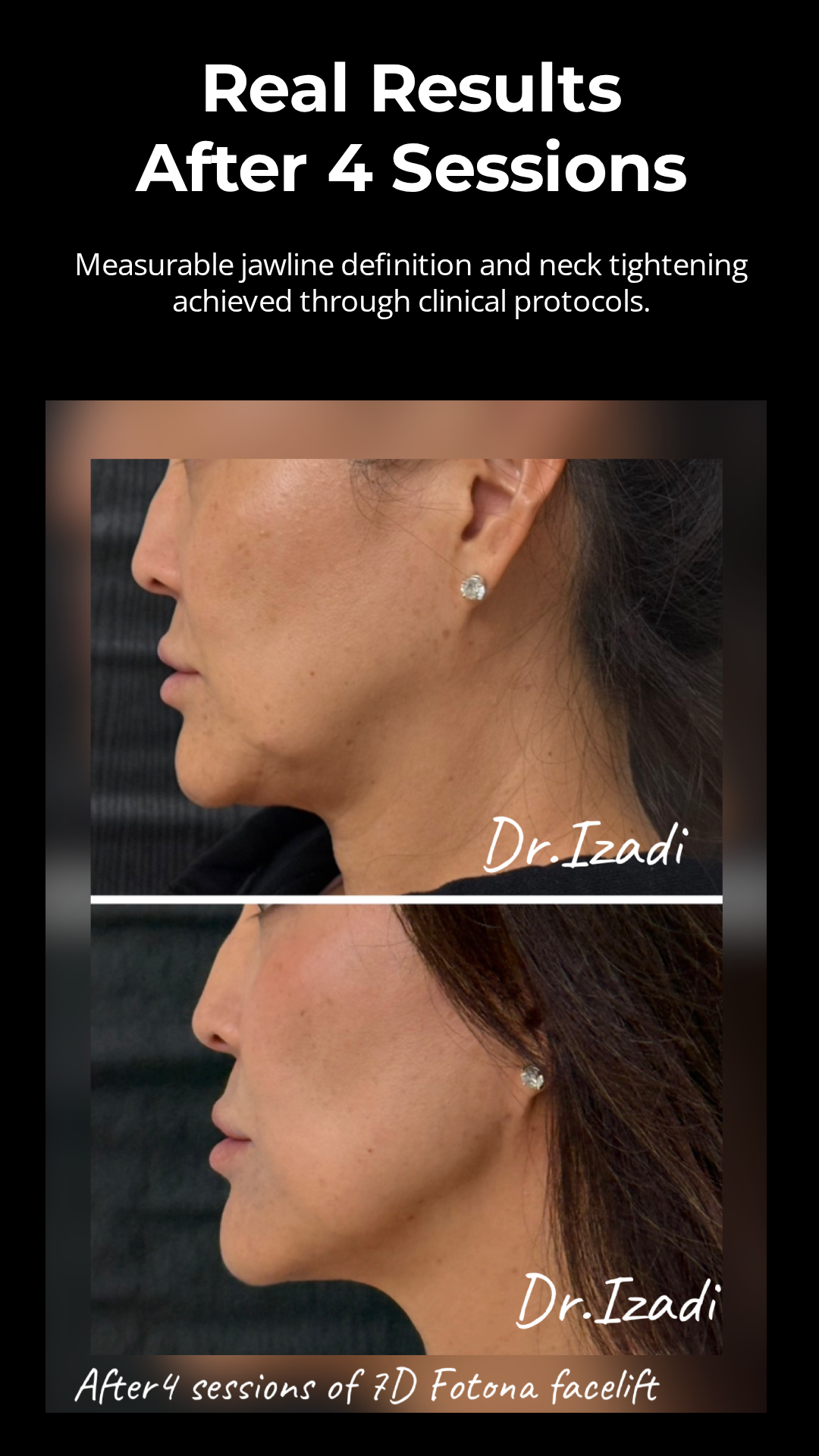
7D facelift has all 4 steps of 4D facelift plus smootheye ( eyelids tightening) vector lift ( eyebrow lift) liplase and also treating the submental area with FRAC3, PIANO and Peel to achieve a nice jaw line.
4D facelift: 1-Intra-oral with a special hand piece that goes inside the mouth to treat naso labial folds, marionette lines and behind the lips from inside the mouth. 2- FRAC3 to get rid of any imperfection and get a glowing skin 3- PIANO to go deeper and tighten and lift 4- peel to remove the old skin and show the fresh and new skin on the face. Fotona uses both Er-YAG and Nd-YAG laser during the facelift.
How does the Fotona 7D facelift work?
The Fotona 7D Facelift is a comprehensive, non-surgical laser treatment designed to address multiple signs of facial aging. Rather than treating only the surface of the skin, the treatment uses different laser modes and treatment depths to target several layers of facial tissue.
Fotona’s Er:YAG and Nd:YAG laser wavelengths can be used in different ways to improve skin texture, stimulate collagen remodeling, support skin tightening, and improve the appearance of facial contours. By combining multiple treatment modes in one personalized protocol, treatment can address concerns such as skin laxity, fine lines, uneven texture, and loss of definition along the jawline.
The goal is gradual, natural-looking rejuvenation without surgery, incisions, or injectable treatment.
Why Collagen Remodeling Matters
Collagen provides structural support to the skin, but collagen production and organization change with age. This contributes to thinner skin, wrinkles, laxity, and changes in facial contours.
Controlled laser energy creates a thermal response within targeted tissues. This can stimulate collagen remodeling and new collagen formation over time. Because this process is gradual, improvement may continue after the treatment as the skin undergoes its natural remodeling response.
Rather than simply creating a temporary tightening effect, the treatment is designed to encourage the skin’s own regenerative processes.
Multiple Dimensions of Facial Rejuvenation
The Fotona 7D approach combines several complementary treatment techniques. Depending on the patient’s anatomy, skin condition, and treatment goals, the protocol may include technologies such as SmoothLiftin, FRAC3, PIANO, SmoothEye, VectorLift, LipLase, and targeted treatment of the jawline and submental area.
Each component has a different purpose. Some treatment modes target deeper tissues and collagen, while others focus more closely on the surface, texture, or specific areas of the face.
Because facial aging occurs at multiple levels, combining these approaches allows treatment to be customized rather than using one laser setting for every concern.
What Areas Can Be Treated?
Fotona facial rejuvenation can be customized to address several areas of the face, including the cheeks, around the mouth, lips, eye area, jawline, and submental region beneath the chin.
Treatment can be adjusted according to the patient’s facial anatomy and degree of skin laxity. This is particularly important because aging does not occur in exactly the same pattern in every person.
What Is Recovery Like?
One of the advantages of a non-surgical laser approach is that extensive surgical recovery is generally not required. Depending on the treatment settings used, patients may experience temporary warmth, redness, sensitivity, or mild swelling.
Downtime varies according to the specific laser modes and intensity selected. Sun protection and appropriate post-treatment skin care are important following laser procedures.
A personalized treatment plan and aftercare instructions are provided based on the patient’s skin type and the procedures performed.
How Many Fotona 7D Facelift Sessions Are Needed?
The number of sessions depends on age, skin quality, degree of laxity, facial anatomy, and individual treatment goals.
At Pristine Wellness Center, treatments are personalized rather than applying the same protocol to every patient. Sessions are generally performed at least one month apart to allow time for tissue response and collagen remodeling between treatments.
Maintenance treatments may also be recommended periodically to support results as the natural aging process continues.
Who Is a Good Candidate?
The Fotona 7D Facelift may be appropriate for adults who want facial rejuvenation but prefer to avoid surgery or injectable treatments. It may be considered for concerns including mild-to-moderate skin laxity, fine lines, changes in skin texture, and reduced facial or jawline definition.
However, laser treatment is not a substitute for surgery in every patient. Significant tissue laxity or advanced structural changes may require a different approach.
A medical consultation is important to determine whether Fotona treatment is appropriate and which combination of treatment modes is most suitable.
Fotona 7D Facelift vs. Surgical Facelift
A surgical facelift physically repositions facial tissues and can produce substantial correction in appropriately selected patients. The Fotona 7D Facelift works differently. It uses laser energy to stimulate tissue remodeling and improve the appearance and quality of the skin without surgical incisions.
For patients who are not ready for surgery or prefer a non-surgical approach, Fotona can provide another option. Results are typically progressive rather than immediate, and expectations should be individualized.
Frequently Asked Questions
Does the Fotona 7D Facelift involve needles?
The laser portions of the Fotona 7D Facelift do not require injectable treatment or surgical incisions.
When will I see results?
Some patients notice early changes after treatment, while collagen remodeling develops progressively over the following weeks and months.
Can Fotona treat the eyes and lips?
Specific Fotona techniques can be used for areas such as the periocular region and lips when clinically appropriate.
Is every Fotona 7D treatment identical?
No. Treatment parameters and modalities should be selected according to the patient’s anatomy, skin characteristics, concerns, and goals.
Does Fotona replace a surgical facelift?
No. Laser rejuvenation and facelift surgery are different treatments. Patients with substantial laxity may achieve greater correction from surgery, while patients seeking gradual rejuvenation without surgery may prefer a laser-based approach.
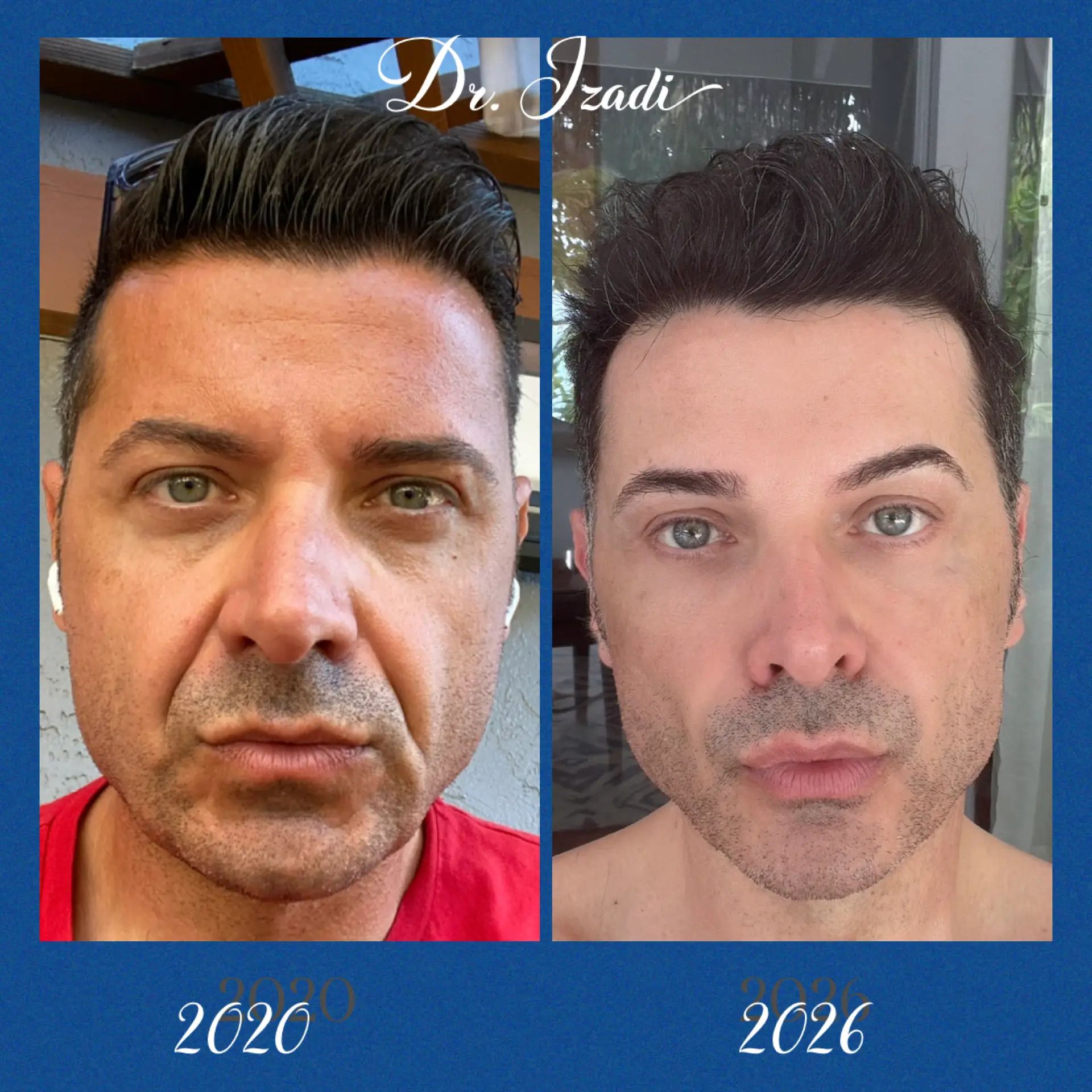
This gentleman has been my patient for the last 7 years, over time he had some Radiesse and Daxxify but the last two treatments right before the after picture were Fotona 7D facelift, so the skin texture, eye area, nasolabial folds and exclusively the result of Fotona laser.
Educational information only. Individual treatment suitability, settings, risks, and expected outcomes require physician evaluation.